Hopalong Cassidy in Australia
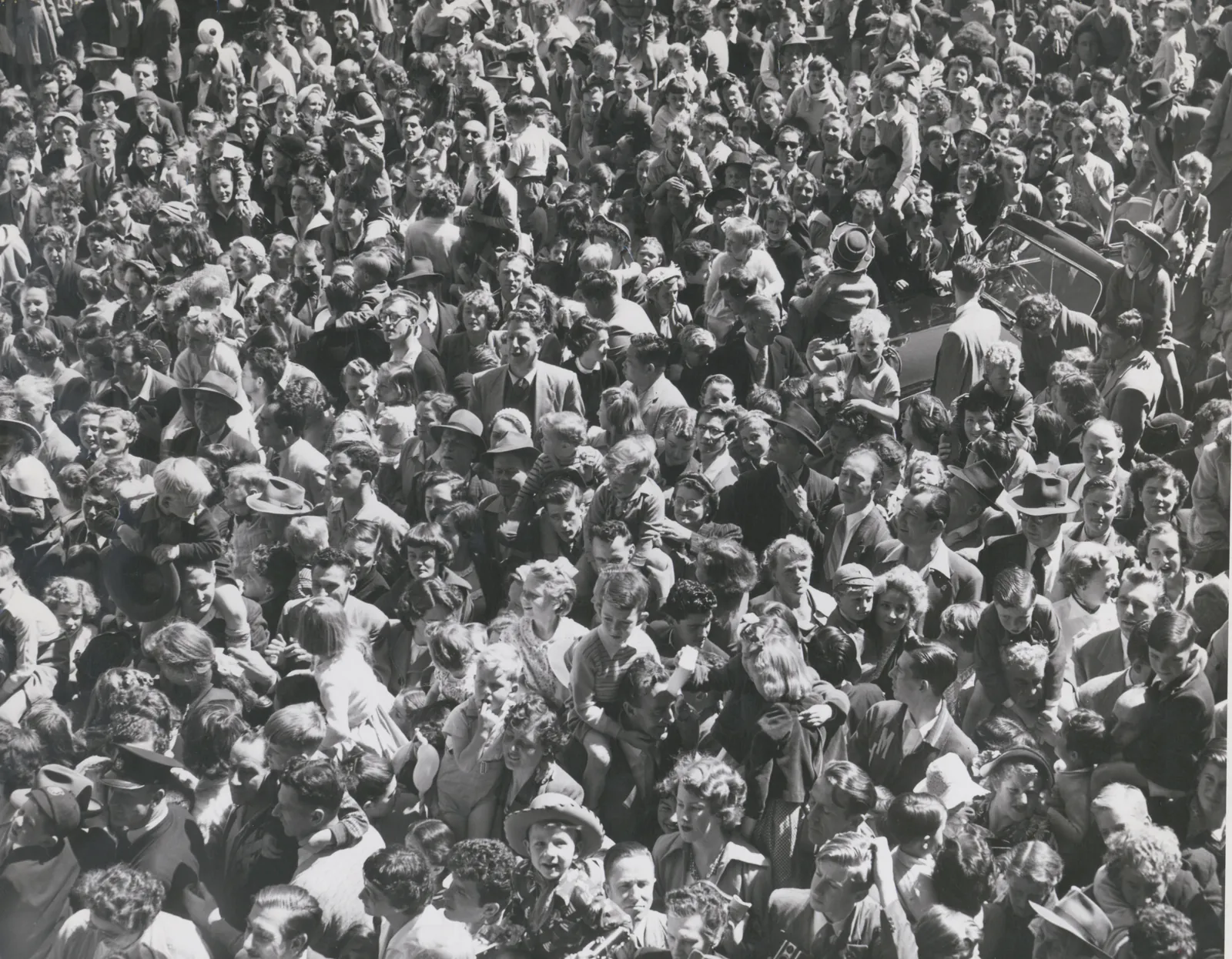
In November 1954, two years before Australia had television, the film cowboy William Boyd spent a fortnight here as Hopalong Cassidy. He went to children in hospitals and schools in Darwin, Sydney, Melbourne and Adelaide for the crippled children’s societies, and took no fee. Wherever he went, the crowds were enormous.
Why he came
In 1954 Hopalong Cassidy was on 500 American radio stations and 30 television stations; three million Hoppy comic books sold every month, his strip ran in more than 100 newspapers, and there were 138 kinds of Hoppy goods. Australia had none of that television yet. Its children knew him from the Saturday matinee, the radio serial and the daily strip in the Sun.
He came at the invitation of the children’s charities of three states: the N.S.W. Society for Crippled Children, the Children’s Welfare Association of Victoria and the Crippled Children’s Association of South Australia. Australia was the last leg of a charity tour round the world that had begun in Britain in July. His wife, the actress Grace Bradley, came too, as Tripalong. He took no fee for any appearance.
Many of the “crippled” children he came for had polio. There was no vaccine yet: the first Salk trials began in Australia that year, and the epidemic would not end until 1956. In March an epidemic in Western Australia had stopped all handshaking on the Queen’s tour of the state. Hoppy hugged and kissed the children he met, ward after ward.
“At my time of life I have no sentimental yearnings for kids, but right now I am on a world tour seeing as many children as possible because I owe them a debt I can never repay.”
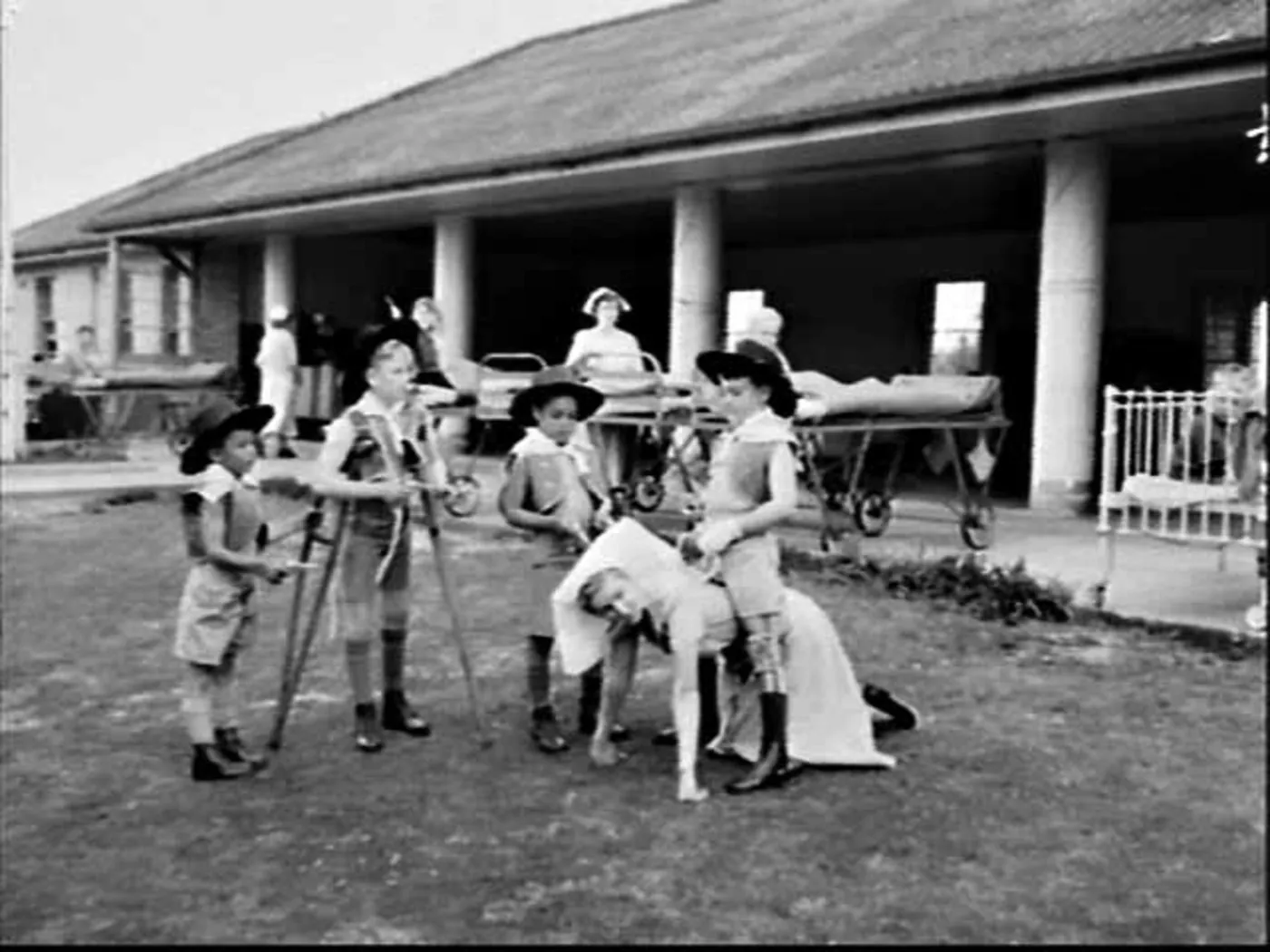
“This was two years before Jonas Salk came up with the vaccine, and people were very frightened. But Hopalong was hugging people, very affectionate. He had a big heart.”
The Sun News-Pictorial, Friday 15 October, p. 6; West Wyalong Advocate, Thursday 18 November, p. 1; The Sydney Morning Herald, Friday 19 November, p. 5; The Sun News-Pictorial, Wednesday 10 November, p. 3; The Sun-Herald, Sunday 7 November, p. 62; The Herald (Melbourne), Saturday 6 November, p. 3; The Sydney Morning Herald, Thursday 4 November, p. 9; The Advertiser, Thursday 11 November, p. 3; Newcastle Sun, Friday 23 July, p. 5; The Sydney Morning Herald, Thursday 18 November, p. 2; The West Australian, Tuesday 23 March, p. 1.
Museums Victoria, Poliomyelitis (Polio) Epidemics in Victoria; National Museum of Australia, Polio vaccine introduced.
Where he went
A fortnight and four cities, day by day, as the papers reported it. Under each day are the articles it comes from; the links go to them on Trove.
Aboriginal and Torres Strait Islander readers are advised that this page names people who have died, and quotes the newspapers of 1954 in the words they used.
Darwin · Tuesday 9 and Wednesday 10 November
The biggest crowd Darwin had seen

The Daily Telegraph, Wednesday 10 November 1954, p. 1 He flew in by Constellation on the Tuesday night, meaning to rest. About a thousand people were at the airport, some from as far as Katherine and Pine Creek, and they rushed the quarantine lines and broke into the Customs lounge. About a hundred Aboriginal people had walked the five miles out from Darwin, and their spokeswoman, Alice Leydin, welcomed him: “I welcome you to our country. You do a lot of good.”
“I thought Darwin was just an airport with 50 residents,” he said. The next afternoon, instead of resting, he went to the convent school, the Government school and the Bagot Road reserve, and met more than a thousand children in under two hours. At the convent kindergarten Leslie Kilmartin, five, in a cowboy hat, pulled a toy pistol on him: “I got you Hoppy.” He flew on to Sydney that night.
“Next day, instead of resting, Hoppy went to the Catholic school, then to the public school, and then to the school where there were a lot of wonderful little aboriginal kids — they were the most wonderful of the lot, and they knew all about Hoppy.”
The Daily Telegraph, Wednesday 10 November, p. 1; Daily Mirror, Wednesday 10 November, p. 3; The Sun-Herald, Sunday 21 November, p. 50; The Advertiser, Thursday 11 November, p. 3; The Daily Telegraph, Saturday 13 November, p. 7.
Sydney · Thursday 11 November, morning
“Hi, kids!”
The Sun (Sydney), Thursday 11 November 1954, p. 1 He landed at Mascot at about seven in the morning to four or five thousand children and their parents. Airport officials said it was the biggest crowd ever seen there, and thirty extra police could not hold it. Customs gave back the pearl-handled .45s they had held since his manager flew in with them a week before. “I’m not going to put them on,” Boyd said. “This is a peace-loving town.” Marilyn Moir, seven, lassoed him as he walked past. At ten he flew on to Melbourne; Sydney would have him back the next week.
“When you look into a kid’s eyes, you’re closer to God than you’ll ever be.”
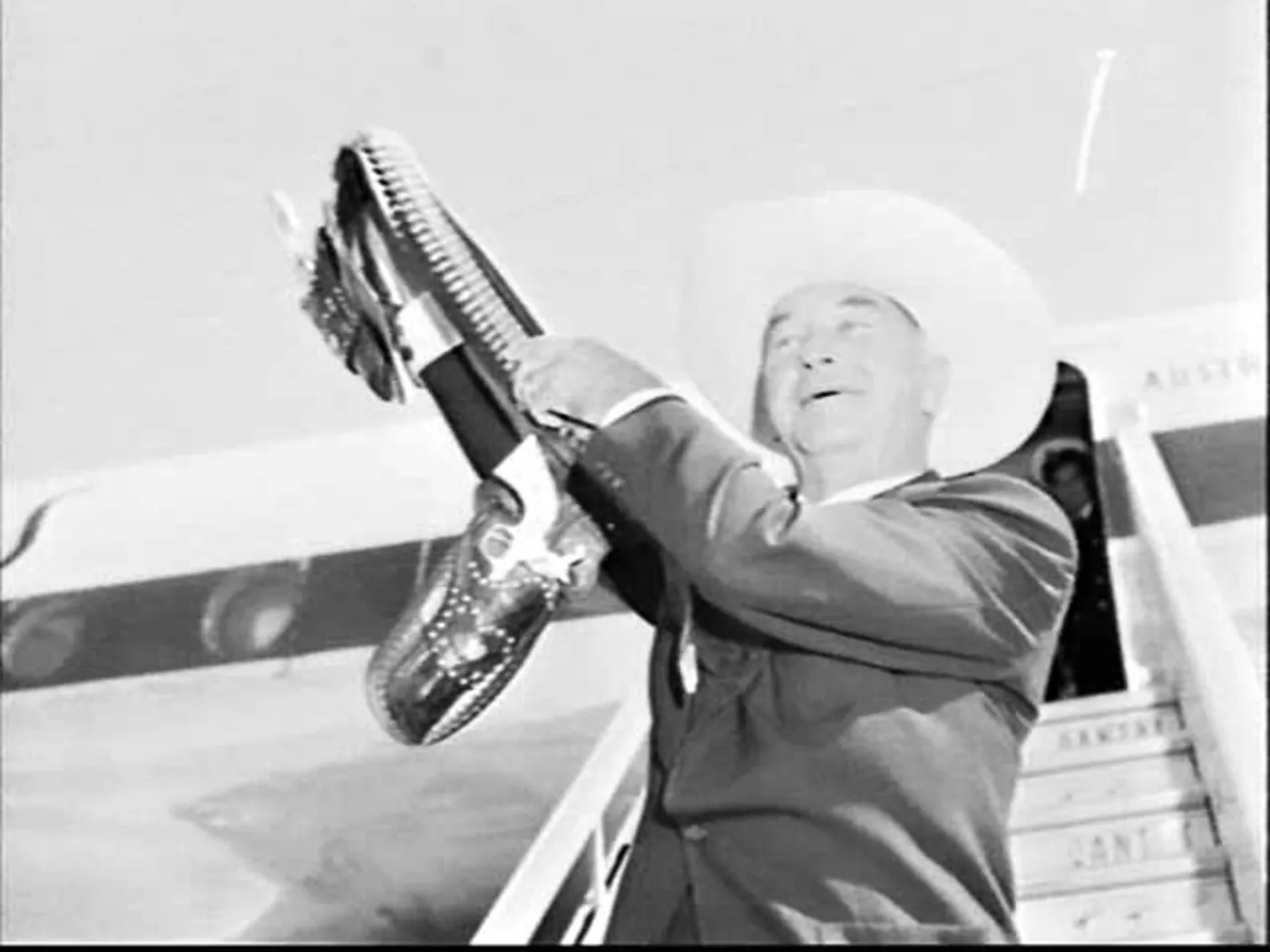
At the door of the Qantas Constellation, Mascot, Thursday 11 November. Animated by AI from the photograph; the movement is ours, not the archive’s. Australian Photographic Agency. Mitchell Library, State Library of New South Wales Daily Mirror, Thursday 11 November, p. 1; The Sun (Sydney), Thursday 11 November, p. 1; The Daily Telegraph, Friday 12 November, p. 7; The Sydney Morning Herald, Thursday 4 November, p. 4.
Melbourne · Thursday 11 November, afternoon
“Not even the welcome the Queen got”

The Herald (Melbourne), Thursday 11 November 1954, p. 1 At Essendon that afternoon five thousand children “cheered themselves into a state of near-hysteria”, the Herald said, and not even the welcome the Queen got had outdone it. Two blind children, Frank and Joy, were brought to him. “Hoppy put his hands on each of their faces in turn, murmured a soft ‘Hi’ in their ear, kissed them, and moved on.” At the civic reception the Lord Mayor, Cr Selleck, put on Hoppy’s hat. By half past six he was in bed at the Windsor.
“People call me Mr. Boyd and I don’t turn around any more … I just automatically answer to Hoppy.”
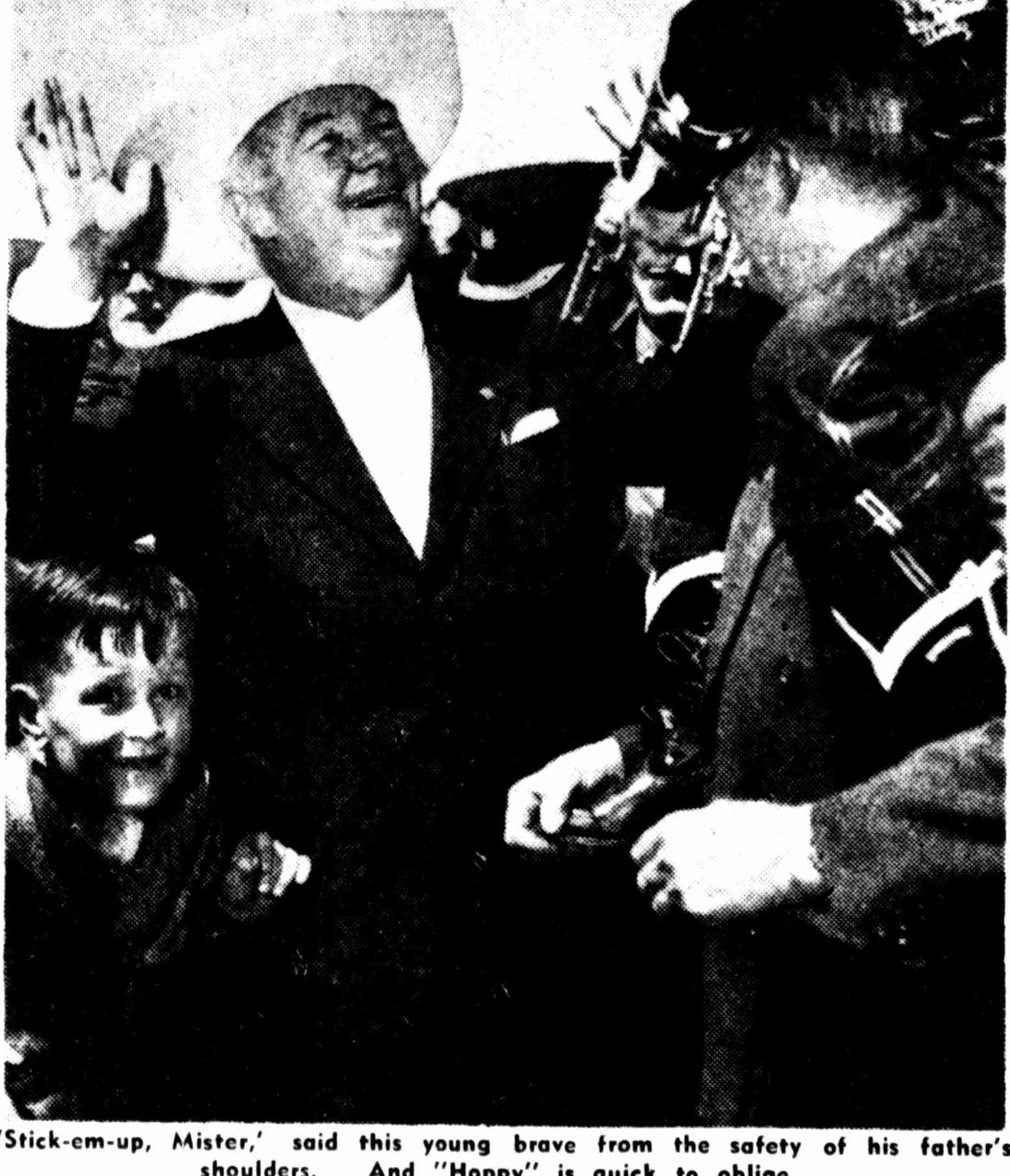
At Essendon, as the Argus printed it the next morning. The Argus, Friday 12 November 1954, p. 5, via Trove The Herald (Melbourne), Thursday 11 November, p. 1; The Sun News-Pictorial, Friday 12 November, p. 1; The Argus, Friday 12 November, p. 5; The Age, Friday 12 November, p. 3; The Age, Tuesday 9 November, p. 3.
Melbourne · Friday 12 November
The hospitals, and the circus
The Age, Saturday 13 November 1954, p. 1 He set out early for the Royal Children’s Hospital: “Hi, little chickens, hi!” At Yooralla School for Crippled Children, Barney McLees, nine, of Albury, stood alone on his crutches inside the gate in a Hoppy outfit; Hoppy drew his guns and advanced, grim-faced, then laughed, bent down and kissed his cheek. At the Victorian School for Deaf Children he hugged or kissed every one of 300 deaf, blind and crippled children. A blind girl, Lorna, asked him to take off his Hoppy voice. He kept talking, and she said, “But you’re just the same.” “That’s right, honey,” he said. “I’m Hoppy — and Hoppy is me.”
At five he was to do a 3AW radio show in Wirth’s Circus tent in Batman Avenue, which seated 5,000. Twelve to fifteen thousand came. Gate-crashers fought ticket-holders, women fainted, and Wirth’s led in two elephants to hold back the crowd. Four crippled children were lifted over the heads of the crowd to safety, the show was abandoned, and Boyd’s outfit was torn. That night he spoke on 3AW instead.
“All you wanted was to see your old friend Hoppy. Believe me, boys and girls, and you wonderful fathers and mothers, all I wanted to see was you.”
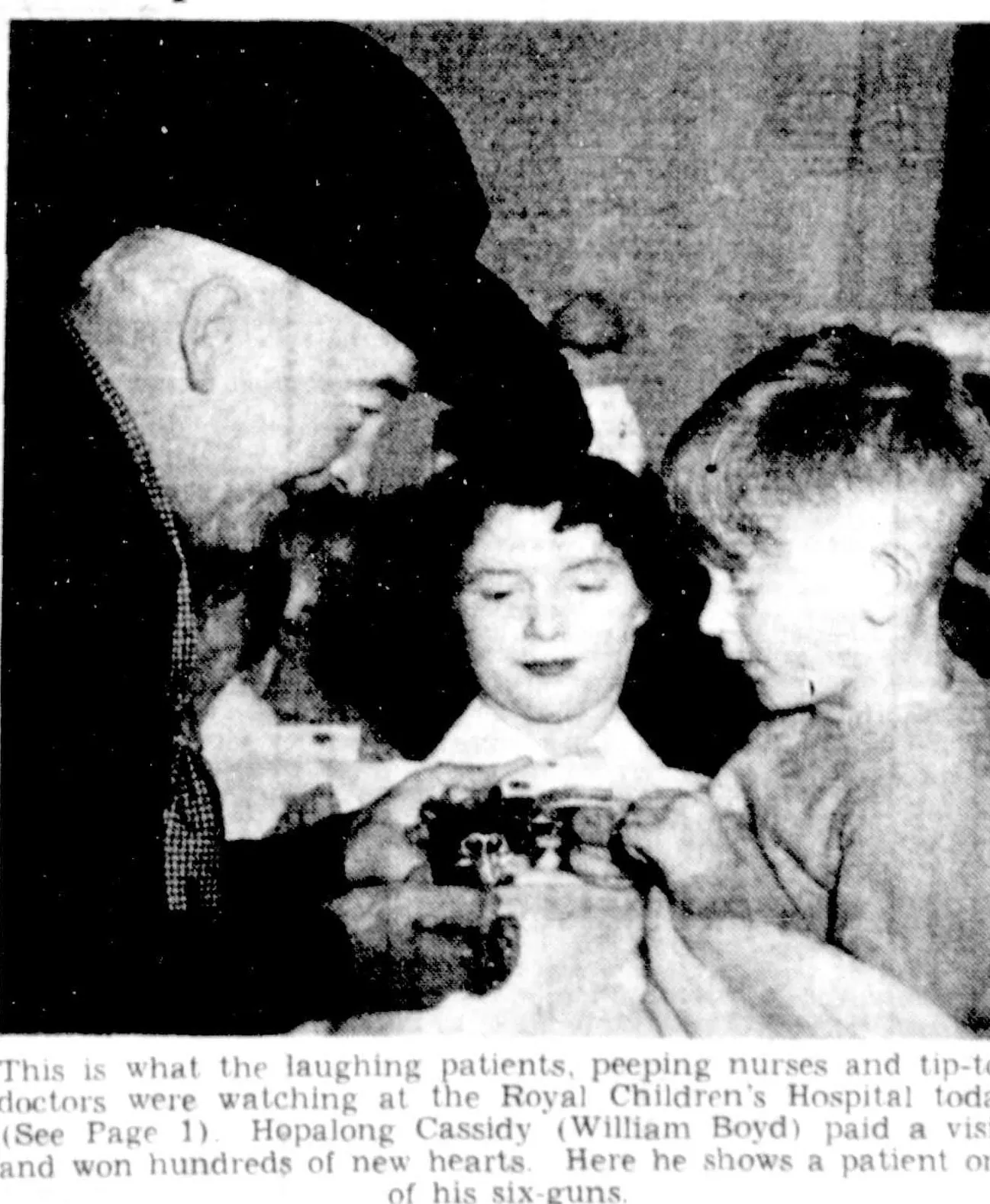
The Royal Children’s Hospital, as the Herald printed it that afternoon. The Herald, Friday 12 November 1954, p. 3, via Trove The Herald (Melbourne), Friday 12 November, p. 3; The Sun News-Pictorial, Saturday 13 November, p. 3; The Argus, Saturday 13 November, p. 3; The Daily Telegraph, Saturday 13 November, p. 9; The Age, Thursday 4 November, p. 1; The Age, Saturday 13 November, p. 1; The Argus, Saturday 13 November, p. 1.
Melbourne · Saturday 13 November
Lonsdale Street, and Albert Park

The Herald (Melbourne), Saturday 13 November 1954, p. 1 The City Council would not let him down Bourke Street on a float on a Saturday, so at nine he rode down Lonsdale Street with Father Christmas, on a £3,000 reindeer float, to two children’s parties at Myer’s. Police put the crowd at 60,000. Children were hurt in the crush, traffic stood still for 45 minutes, and police had to drag him into the store and smuggle him out again to a car waiting near Lynch Alley. At one of the parties a boy of five with polio, Ray Johnston, strapped in irons, was handed up to him. He kissed him.
Rain had flooded Flemington, where the round-up was to be, so at three he was driven round Albert Park Lake instead, in a Land Rover, three miles at a crawl for 85 minutes, throwing kisses with both hands. Another 60,000 had waited up to three hours in the sun.
“This morning I’ve been up to my neck with children. They’re everywhere and they’re wonderful.”
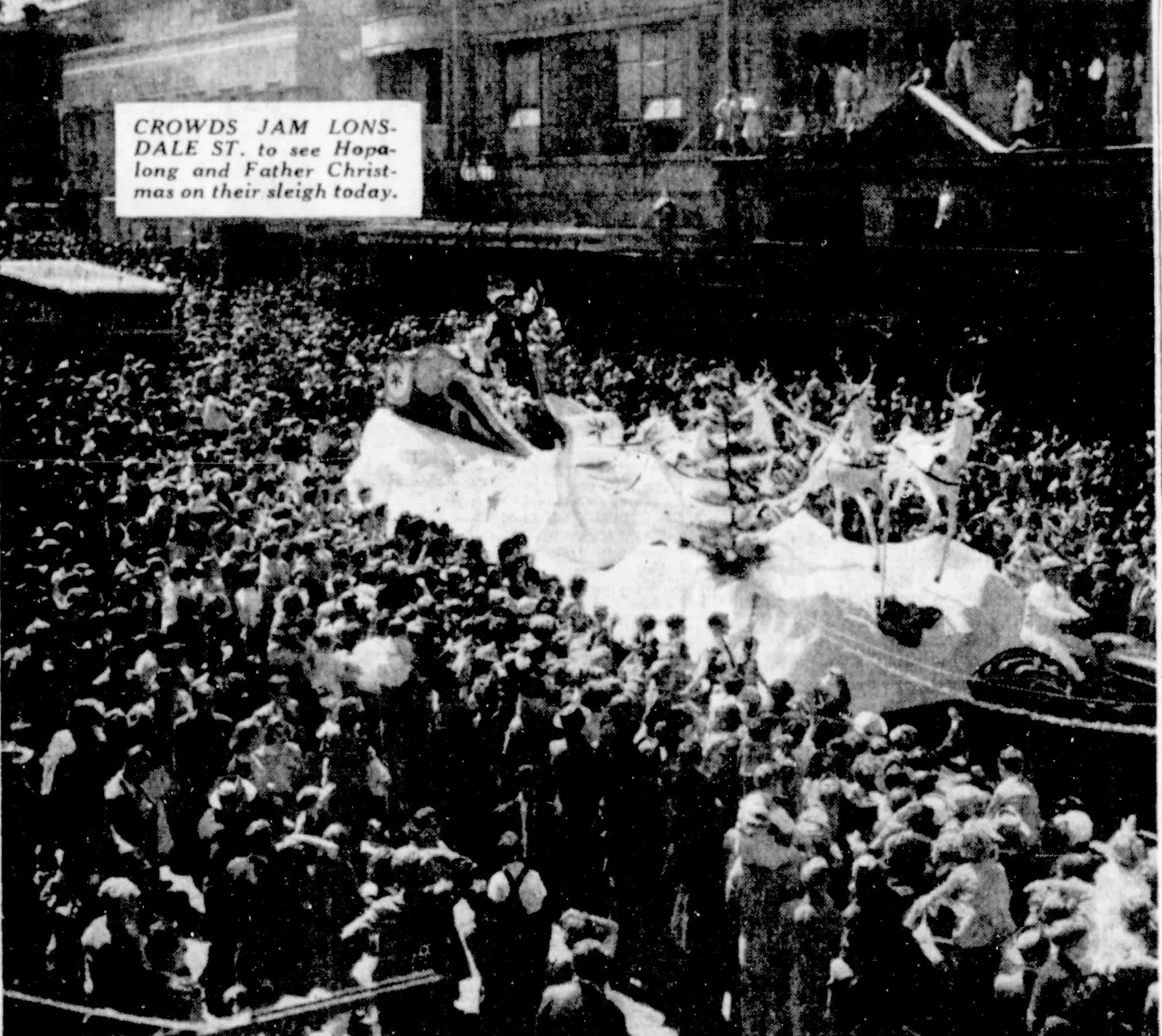
The float in Lonsdale Street, from the Herald’s front page that afternoon. The Herald, Saturday 13 November 1954, p. 1, via Trove The Argus, Saturday 6 November, p. 3; The Argus, Saturday 13 November, p. 3; The Herald (Melbourne), Saturday 13 November, p. 1; The Sun News-Pictorial, Monday 15 November, p. 11; The Herald (Melbourne), Wednesday 10 November, p. 3; The Age, Monday 15 November, p. 5; The Mail (Adelaide), Saturday 13 November, p. 80.
Frankston · Sunday 14 November
“There are no crippled children in my eyes”
He drove out through Dandenong to the Frankston Orthopaedic Hospital and spoke to every one of its 120 children who was old enough and well enough to speak, shook hands with every boy, kissed every girl, and signed their plaster. Aaron Atkinson, six, from Mooroopna, in hospital with polio, his right arm and leg in plaster, handled Hoppy’s six-shooters: “He’ll do me for a mate.” A little girl said, “It’s the only fairy tale that’s ever come true for me.” Children waiting along the bayside road cried when they heard he had gone the other way.
That evening, as the ABC’s Guest of Honour, he told Australia to hurry up and get television: “Television has given the kids back to mum and dad and mum and dad back to the kids.”
“There are no crippled children in my eyes — all children are perfect and beautiful.”
The Sun News-Pictorial, Monday 15 November, p. 3; The Argus, Monday 15 November, p. 7; The Herald (Melbourne), Monday 15 November, p. 3.
Adelaide · Monday 15 November
War whoops at Parafield
Melbourne saw him off at Essendon in the morning (“I’ve just about lost my voice”). He landed at Parafield at 1.20 to war whoops and cap guns, and the Advertiser reckoned 60,000 people lined the Main North Road as he drove into the city. At the Somerton Crippled Children’s Home (“Let’s go see the cherubs”) he gave each child a Hopalong medal. At the Town Hall reception he asked for a cup of tea, and on the way out he fed a bunch of carrots to a police trooper’s horse.
“We have a saying in America that after all is said and done, there’s usually more said than done. I’m gonna try to DO all I can for the crippled children here.”
The Herald (Melbourne), Monday 15 November, p. 3; The Advertiser, Tuesday 16 November, p. 1; The Advertiser, Tuesday 16 November, p. 3; News (Adelaide), Monday 15 November, p. 1.
Adelaide · Tuesday 16 November
Norwood Oval, and a boomerang
Storekeepers left their counters and road gangs dropped their shovels as he drove out to Estcourt House at Grange; on the way he stopped his car to talk to a girl who was being kept alive on oxygen. Then the spastic centre at Ashford, Government House, and the Adelaide Children’s Hospital, where he met about 300 children. Two of them, badly burned in the fire that had killed their baby brother on the Saturday, asked to see his guns. “Do you shoot cowboys?” asked Josephine. “Why, no, ma’am. I don’t shoot cowboys — only bad ’uns.”
That night 15,000 people packed Norwood Oval. Hoppy and Tripalong drove twice round the ground with cowboys riding escort and firing into the air, and at the boomerang display one whizzed within inches of his Stetson; he drew a Colt and made to shoot it down. The fund for South Australia’s crippled children passed £6,000.
“I look upon Hoppy as the means to an end. Hoppy himself can do very little without the support, help and love of you wonderful people.”
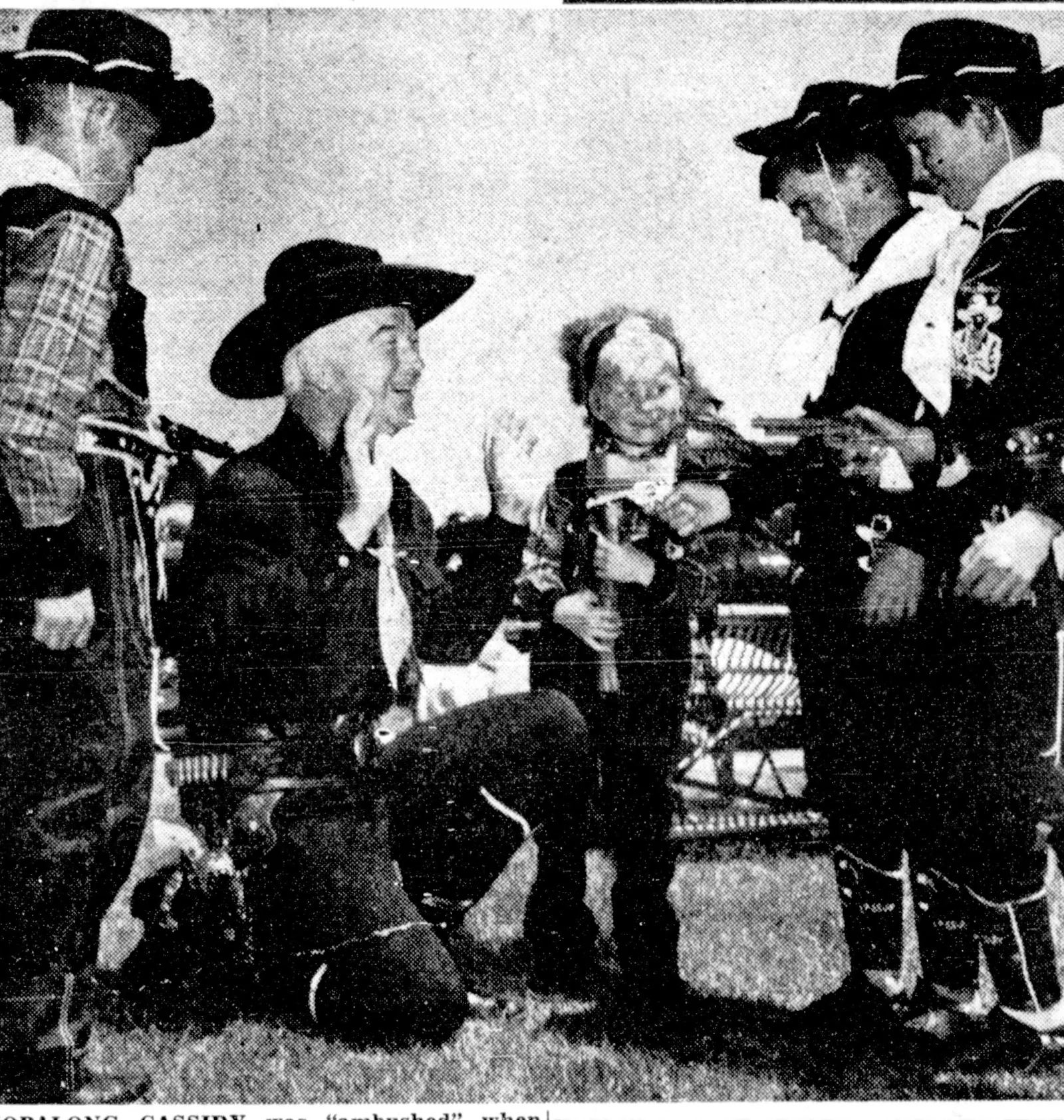
“Hopalong Cassidy was ‘ambushed’ when leaving Estcourt House, Grange, today, but he cheerfully ‘surrendered’ to his junior ‘captors.’ Staging the hold-up are (from left) Gene Swinstead, his brother Julian (dressed as an Indian), Phillip Griffiths, and Gordon Brabyn.” The News (Adelaide), Tuesday 16 November 1954, p. 3, via Trove The Advertiser, Wednesday 17 November, p. 3; The Advertiser, Wednesday 17 November, p. 1; News (Adelaide), Wednesday 17 November, p. 6; Daily Mirror, Wednesday 17 November, p. 1.
Sydney · Wednesday 17 November
“Guess I’ll call it Skipalong”
The Sydney Morning Herald, Thursday 18 November 1954, p. 5 He left Parafield at seven, with children in pyjamas and dressing gowns along the Main North Road, and was back at Mascot by mid-morning, where Paul Heywood, two and a half, hoisted onto his shoulders, punched him on the jaw. More than 3,000 people waited for him at the Town Hall, a hundred schoolboys invaded the reception, and a guest called out, “Shut the door! They’re coming through the window.” At the reception he was given a silver kangaroo for his lapel.
“Mr. Mayor gave it to me to-day. Guess I’ll call it Skipalong.”
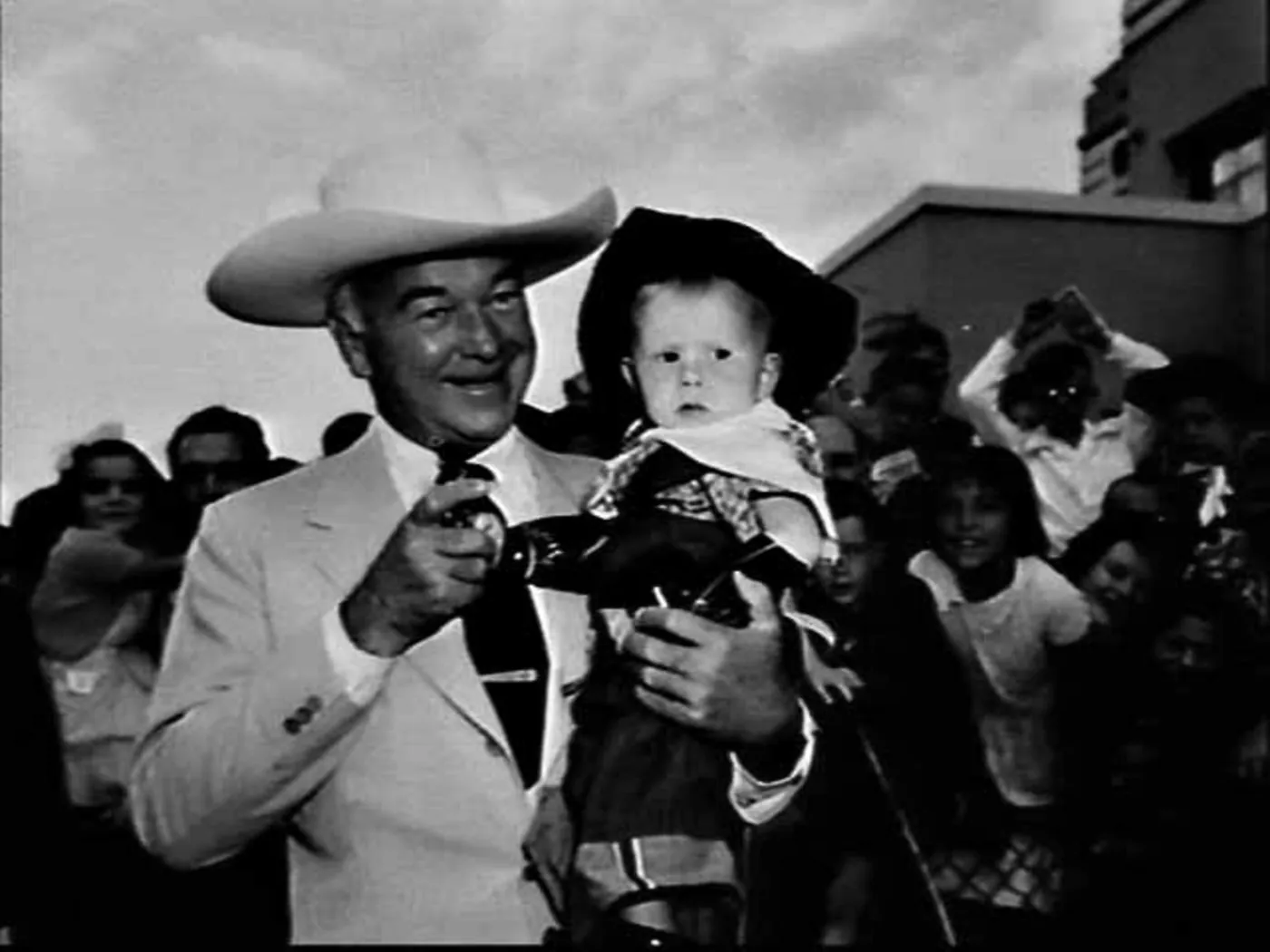
Back at Mascot, Wednesday 17 November. Animated by AI from the photograph; the movement is ours, not the archive’s. Australian Photographic Agency. Mitchell Library, State Library of New South Wales The Advertiser, Thursday 18 November, p. 3; The Sydney Morning Herald, Thursday 18 November, p. 5; The Sydney Morning Herald, Thursday 18 November, p. 1; The Sydney Morning Herald, Thursday 18 November, p. 2.
Sydney · Thursday 18 November
Standing in for Topper
Topper had stayed in California because of quarantine. After ten minutes with the Governor, Sir John Northcott, Hoppy went to the Society’s two hospitals. At Strathallan, Turramurra, he stood in for his horse and gave a ride to Brian Freney, two, a polio patient just beginning to learn to walk. Denise Gibson, eight, could only cry. At the Margaret Reid Hospital, St Ives, Lynnette Coventry, three, broke away from her nurse, ran down the ward and threw herself into his arms.
“Yore a gran’ girl. Just let ’em go. It’s good for you.”
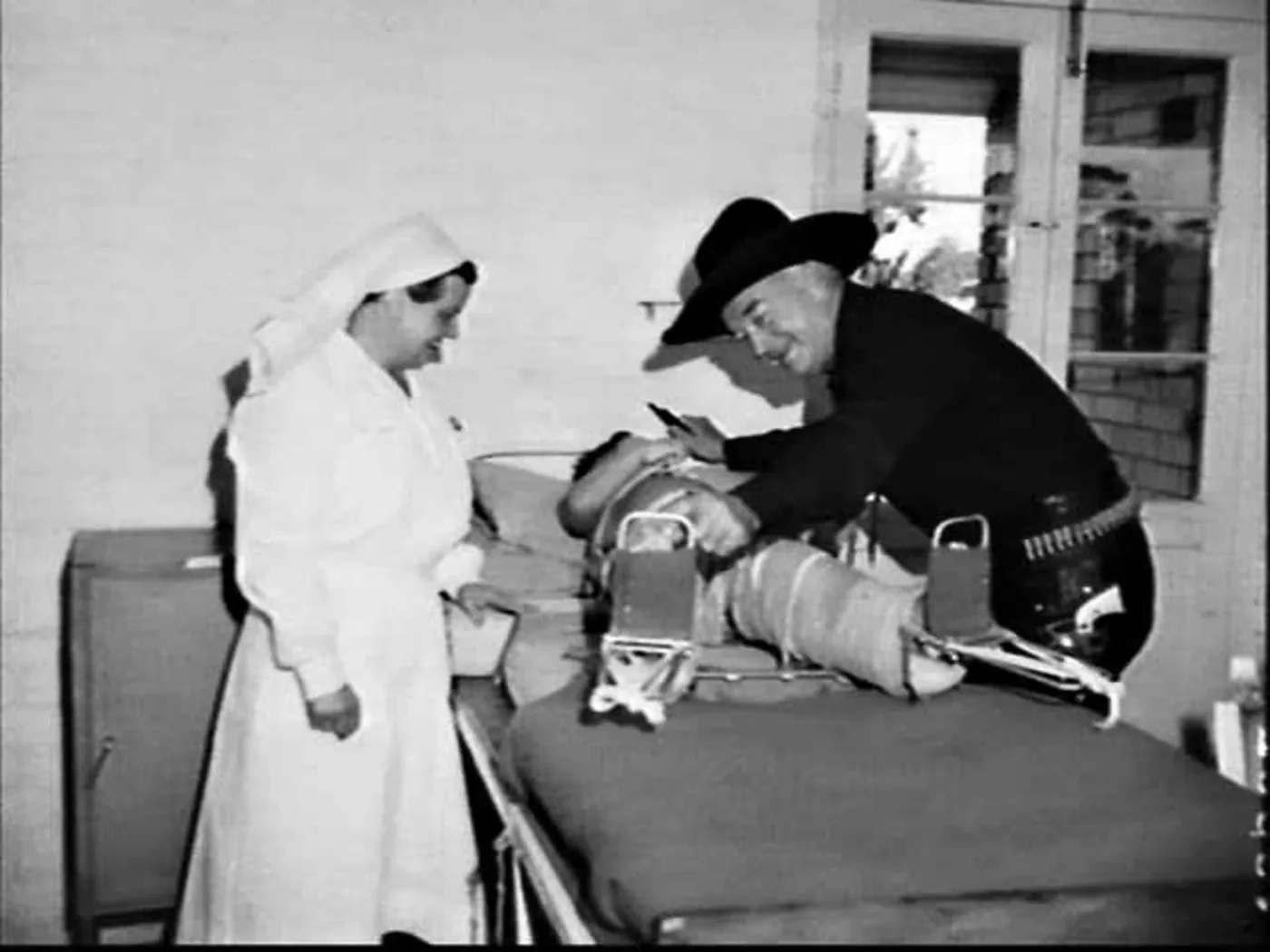
Strathallan Hospital, Turramurra, Thursday 18 November. Australian Photographic Agency. Mitchell Library, State Library of New South Wales Daily Mirror, Wednesday 10 November, p. 8; The Daily Telegraph, Friday 19 November, p. 16; Daily Mirror, Thursday 18 November, p. 11; The Sydney Morning Herald, Friday 19 November, p. 5.
Sydney · Friday 19 November
“You bet”
At the Royal Alexandra Hospital for Children, Camperdown, every window on every floor was full of small faces, many of them bandaged, and he went from bed to bed through most of its 600 patients. George Lane, deaf and blind, could not see him or hear him, so Hoppy traced “Hi, pal!” on his chest with a finger. “Hi, Hoppy,” said George. “Can I have a medal?” Hoppy traced “You bet.” At the Broderick School he laid a foundation stone and left the print of his spurred boots in the wet cement. That evening about 10,000 children and parents cheered him at Sydney Stadium, and hundreds of the children fired their cap guns in salute.
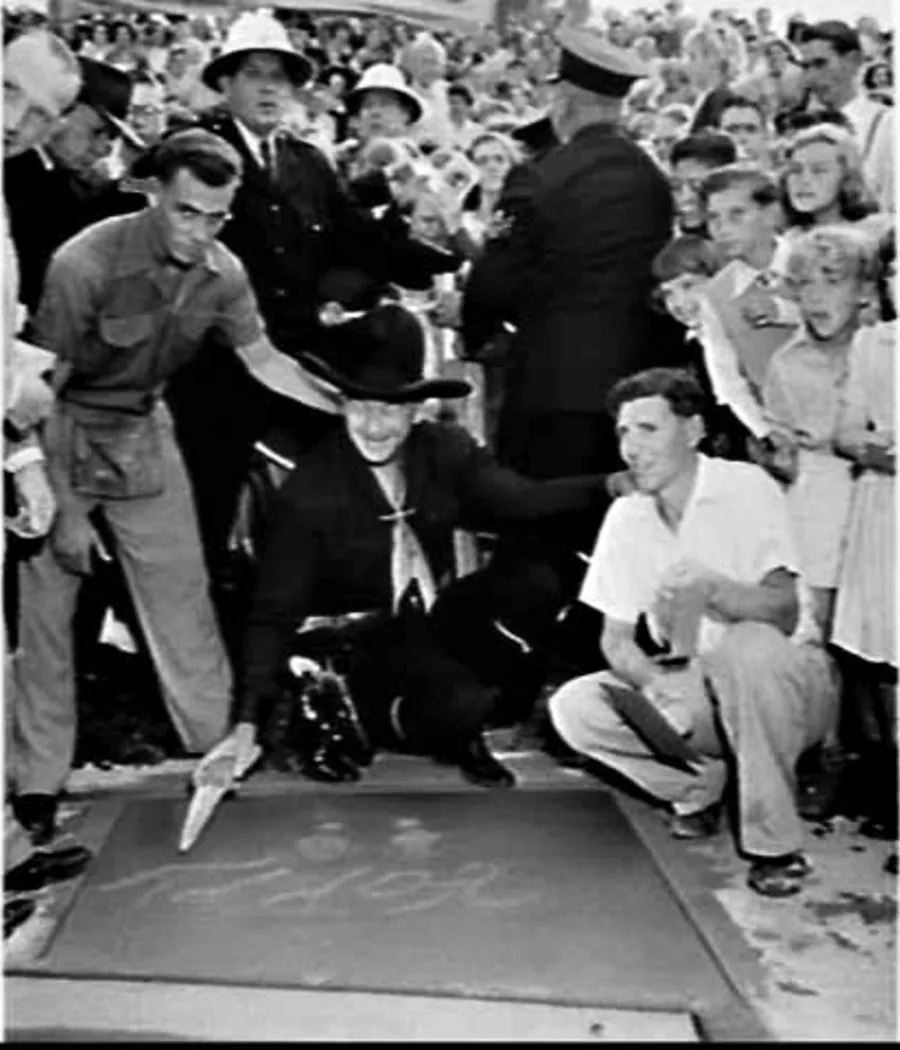
In the wet cement at the Broderick School, Friday 19 November. Australian Photographic Agency. Mitchell Library, State Library of New South Wales Daily Mirror, Friday 19 November, p. 1; Advocate (Burnie), Saturday 20 November, p. 3; The Sydney Morning Herald, Saturday 20 November, p. 7; The Daily Telegraph, Saturday 20 November, p. 21.
Sydney · Saturday 20 November
The Capitol, the Trocadero, the Showground
A 400-yard queue of children in western outfits waited for his matinee at the Capitol, where he asked the electrician to turn the spotlight off him and onto the children he had come to see. Four thousand more came to his party at the Trocadero, where Richard Nee, five, handed him a cheque for £231 from the City Fish Market. At night more than 40,000 people came to his carnival at the Showground, escorted by mounted police and a hundred horsemen in western costume. Heavy rain stopped the show for a while, and then he rode round the ring in an open car.
“Since I arrived in Sydney I’ve kissed an awful lot of girls, and the truth is that my wife at this moment is busy washing handkerchiefs that are covered in lipstick.”
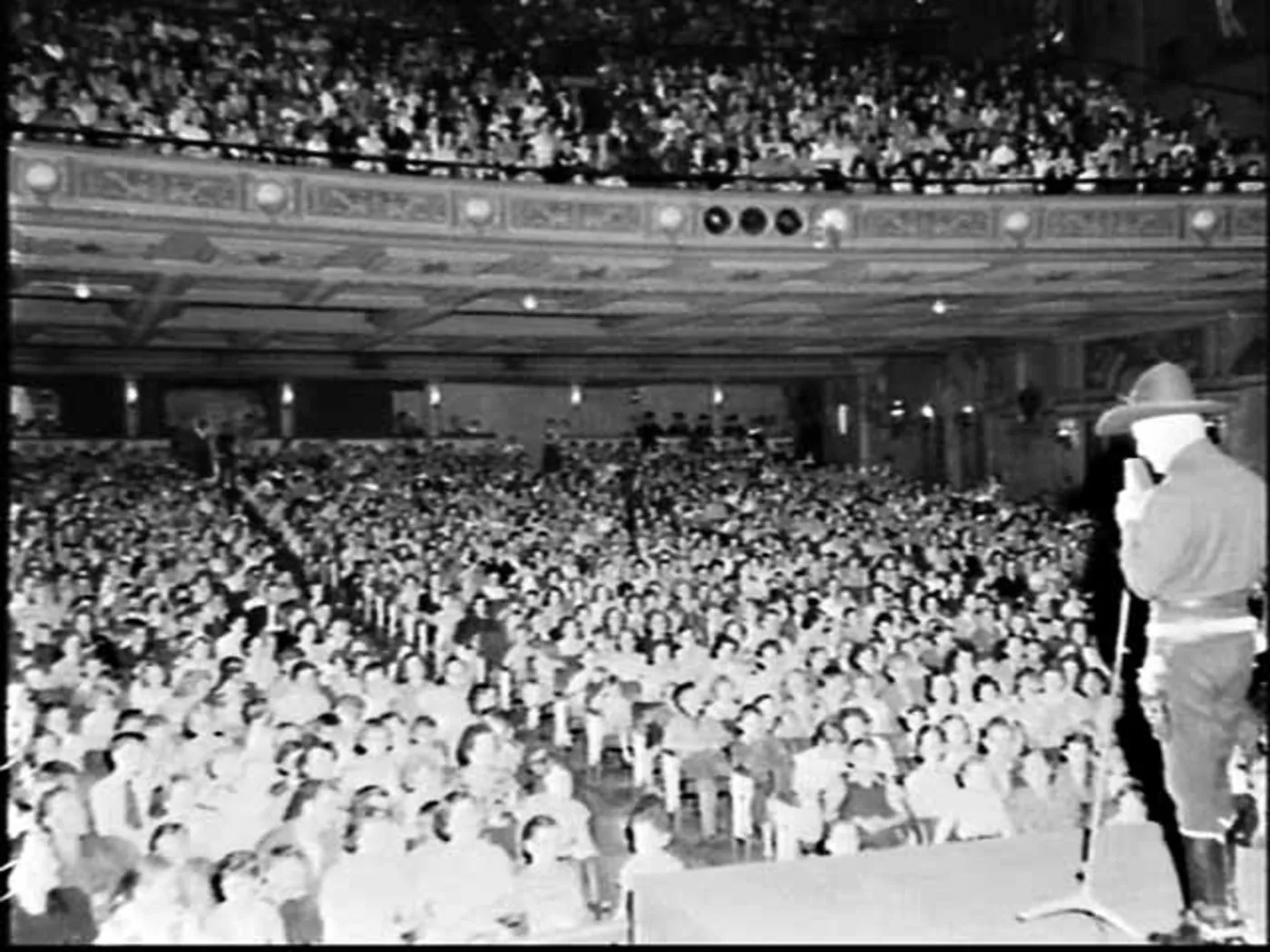
The Capitol, Saturday 20 November, from the stage. Australian Photographic Agency. Mitchell Library, State Library of New South Wales The Sun (Sydney), Saturday 20 November, p. 3; The Sun-Herald, Sunday 21 November, p. 7; Truth (Sydney), Sunday 21 November, p. 2.
Sydney · Sunday 21 to Wednesday 24 November
“Bye, kids”
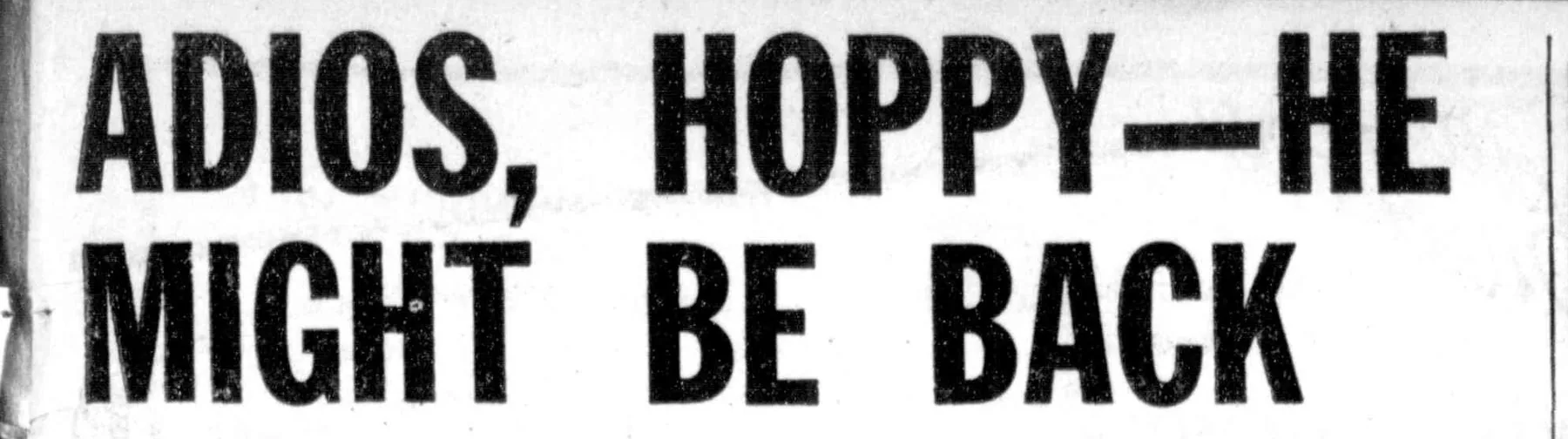
The Sun (Sydney), Wednesday 24 November 1954, p. 9 The Society gave him a dinner at the Rex Hotel, King’s Cross, on the Sunday. Then he barred the door of his suite at the Hotel Australia and rested for two days, “just plain tired”. On the Wednesday afternoon, with a couple of hundred children at Mascot, he left by Qantas Constellation for Manila, fifteen minutes late because he stopped to sign their autographs.
“If there’s one crippled child that will be put on its feet again through our visit it’s been well worth the 17,000 miles we travelled to get here.”
The Daily Telegraph, Monday 22 November, p. 2; The Daily Telegraph, Tuesday 23 November, p. 16; The Sydney Morning Herald, Wednesday 24 November, p. 1; The Sun (Sydney), Wednesday 24 November, p. 9; Daily Mirror, Wednesday 24 November, p. 10.
What it raised
| State | Raised | Who said so, and when |
|---|---|---|
| South Australia | about £6,000 | the Crippled Children’s Association, the day after Norwood Oval. The Advertiser, Thursday 18 November, p. 3 |
| Victoria | about £10,000 | Lady Angliss, president of the Children’s Welfare Association, the day he left Melbourne. The Daily News (Perth), Tuesday 16 November, p. 2 |
| New South Wales | £25,000 | Mrs Coles, wife of the Society for Crippled Children’s president, estimating while he was still in Sydney. The Daily Telegraph, Tuesday 23 November, p. 16 |
| New South Wales | “only £4000” | the Society’s general secretary, a fortnight after he left. The Biz, Wednesday 8 December, p. 23 |
Nothing found in the papers to the end of 1954 gives a final total, or says whether these were before or after costs.
“But you cannot measure in money the good he has done to sick and crippled children.”
“During his tour of Australia Hopalong Cassidy never turned from one child.”
Hoppy goods
Ten thousand aluminium Hopalong Cassidy good-luck medals came out on the freighter Ventura in the middle of a wharf strike. The strikers agreed to unload them for the crippled children, and then nobody could find the box: 32 men searched two holds at up to 103 degrees, and a foreman stevedore found it behind 700 tons of cargo.
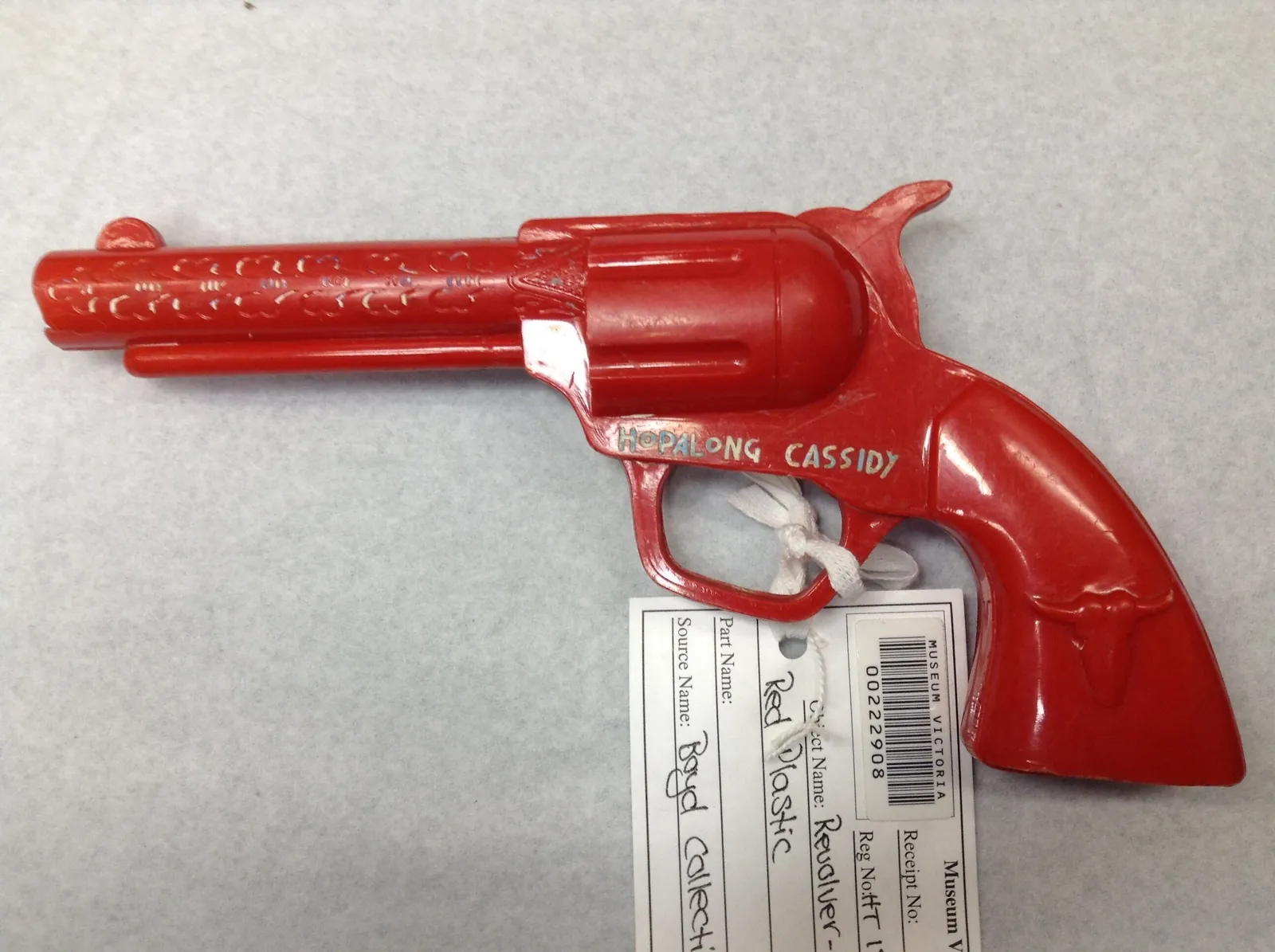
In Sydney 267 stores had Hopalong clothes, suits, guns and hats in the window, and a two-shilling Hoppy badge, sold in the shops, was the ticket to his round-ups. In Adelaide more than 5,000 children had raised £3,500 for the Somerton home before he came, many of them through the Sunday Advertiser’s Hopalong Cassidy Club, whose members each promised to try to raise a pound. Capitol’s records of Hopalong Cassidy and the Mail Train Robbery reached the shops the day he did.
Not everyone was charmed. A man in Bouldercombe wrote to the Morning Bulletin: “Hopalong Cassidy is the spearhead of a devilish scheme, not only to demoralise the rising generation … but to capitalise in a big way on sales of cowboy suits, pistols, knives and other paraphernalia of a supposed Wild West. … Move along, Cassidy! There are lots of us you have not bewitched.”
The Sydney Morning Herald, Thursday 11 November, p. 1; Daily Mirror, Wednesday 10 November, p. 3; The Daily Telegraph, Saturday 13 November, p. 9; The Sydney Morning Herald, Thursday 18 November, p. 2; The Herald (Melbourne), Wednesday 13 October, p. 26; News (Adelaide), Friday 5 November, p. 7; The Advertiser, Monday 18 October, p. 6; The Sun (Sydney), Thursday 11 November, p. 23; Morning Bulletin, Wednesday 17 November, p. 5.
After he left
In Adelaide, Gene Swinstead, nine, and his little brother Julian were given Hoppy suits, and by the first of December they had worn them to hold up three hotels, at Woodville, Kilkenny and Grange, for about £28 for their crippled mates at Estcourt House, where Julian had been a patient. Glenelg’s first Christmas pageant had Father Christmas riding in the open car Hoppy had used.
He was home by Christmas, and sent a message to the children of Australia, “particularly the sick and the crippled”. He hoped to come back the next year, and in 1955 he wrote that next time he wanted to see Brisbane. Nothing found in the papers says he came.
“Now that I know the difference between a kangaroo and a wallaby and a bandicoot, oh, yes, and the duck-billed platypus, I’m telling my friends to visit Australia, the land of to-morrow, and to meet my young cobbers. … A happy Christmas to all of you. Dinkum!”
News (Adelaide), Wednesday 1 December, p. 3; News (Adelaide), Saturday 11 December, p. 11; The Sun-Herald, Sunday 26 December, p. 6; The Telegraph (Brisbane), Thursday 14 July 1955, p. 2.
The books
Derham Groves has been gathering the tour since 2012, when he began talking to people who saw Hoppy in 1954; he spoke to two dozen of them, and in 2013 the Sydney Morning Herald printed his call for more. He has written on Darwin’s two days, and on the whole tour.
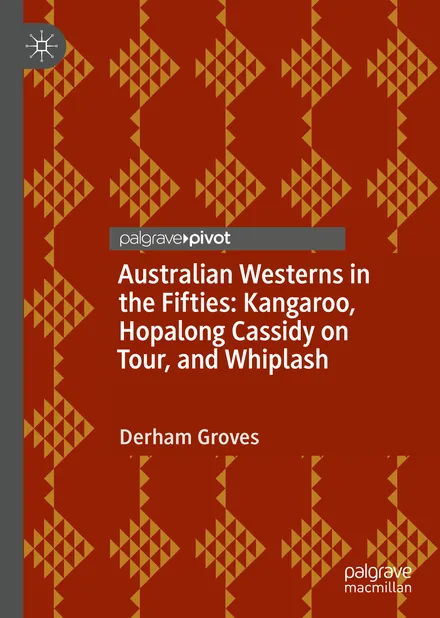
Australian Westerns in the Fifties
Kangaroo, Hopalong Cassidy on Tour, and Whiplash
Derham Groves. Palgrave Macmillan, 2022. ISBN 978-3-031-12882-0.
Hardcover 2022, softcover 2023, and as an ebook. Chapter 2, “Hopalong Cassidy on Tour”, is pages 49–90.
The tour as a whole: the welcome in Darwin, especially from its Aboriginal people, who were among his biggest fans; his day in Melbourne on 12 November, from the Royal Children’s Hospital to the riot at Wirth’s Circus; and the Australian-made Hoppy goods, from Hoppy Cola to the Hopalong Cassidy Game. Groves interviewed people who were there.
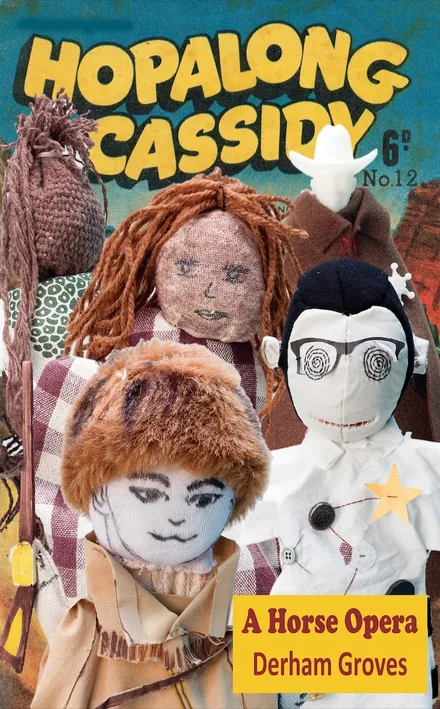
Hopalong Cassidy: A Horse Opera
Derham Groves, with photographs by Lee McRae. Hog Press, 2017. ISBN 978-0984894246.
Paperback, 176 pages.
Three parts: “Bang! Bang! Hopalong Cassidy Takes Darwin”, an account of Boyd’s two days in Darwin; “Hopalepidopter Almost Takes Darwin”, the libretto Groves wrote for a punk space opera at the 2014 Darwin Festival; and McRae’s photographs of the hand puppets his architecture students made of its characters.
Bang! Bang! Hopalong Cassidy takes Darwin
Derham Groves. Historical Society of the Northern Territory, 2015.
Occasional Paper no. 27, 17 pages; a digital download.
Boyd’s two days in Darwin, day by day.
Where this comes from
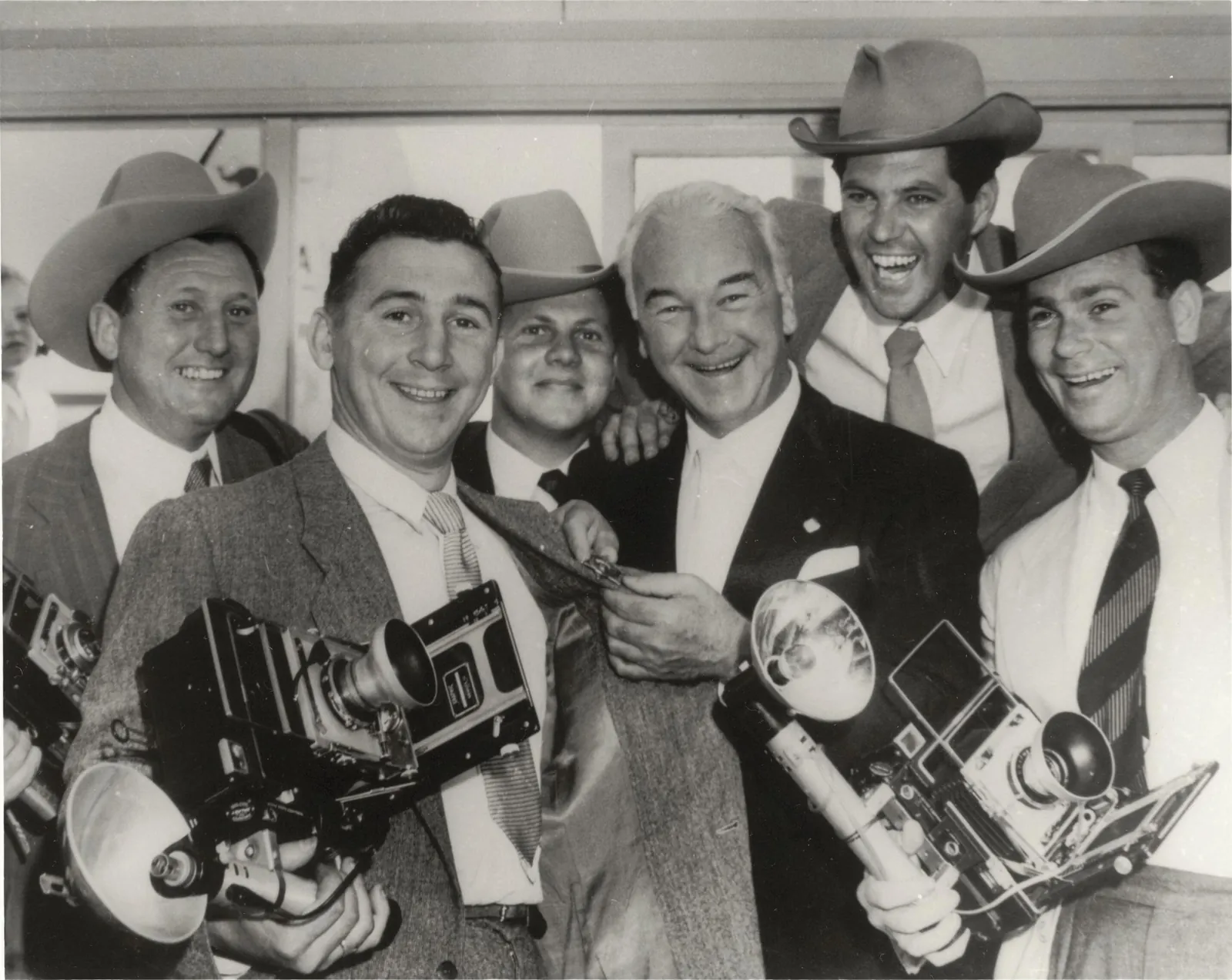
Every fact here is from the newspapers of 1954, read on the National Library’s Trove, and every quotation is as they printed it, the drawl and all. Where the papers disagree, about a crowd or a date, the page gives the figure most of them gave, and its sources say which. The photographs are the State Library Victoria’s, the National Library’s and Museums Victoria’s, each credited where it is shown and linked to its record.